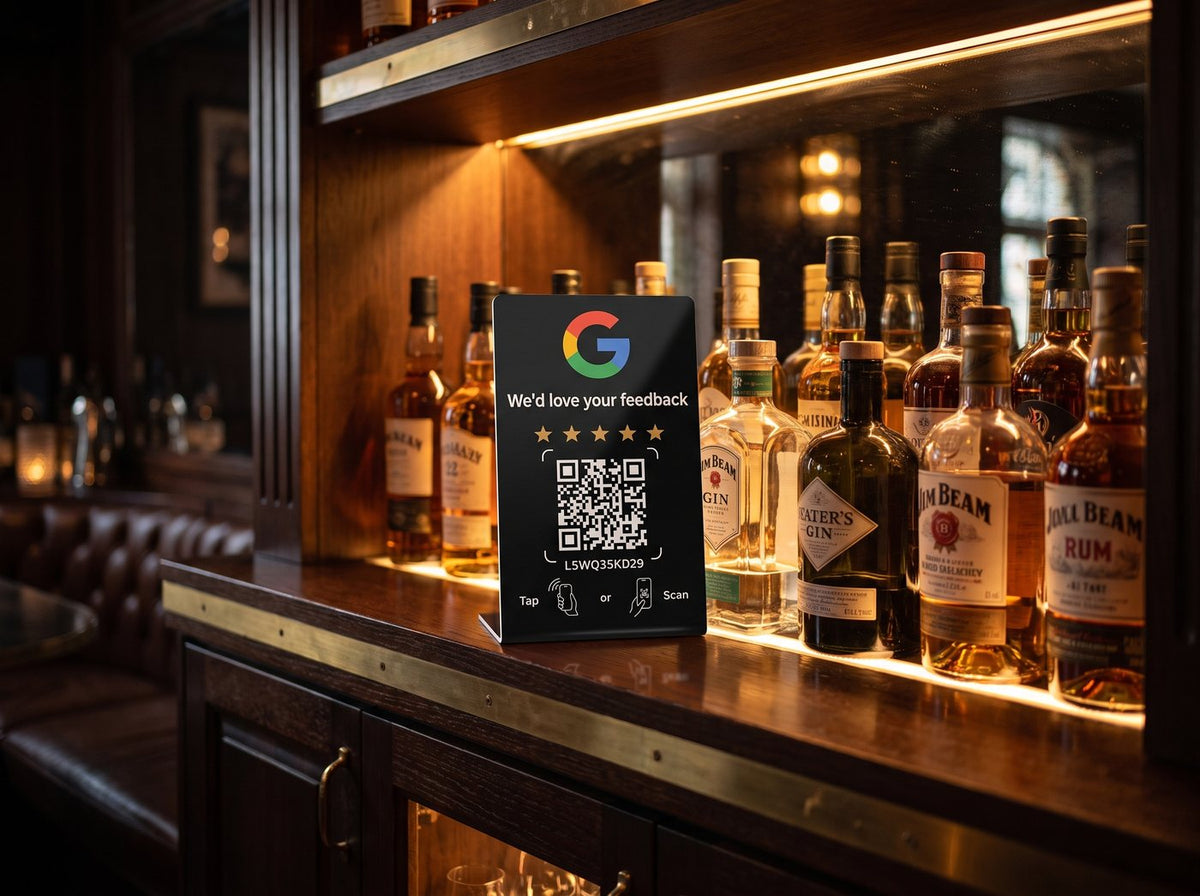
Short answer: yes. Google's policy explicitly allows a business to "solicit or encourage the posting of content that does represent a genuine experience, without offering incentives to do so or attempting to influence the rating or the contents of the review" [1]. Asking is fine. How you ask is where businesses get their profiles suspended.
The three rules that do all the work
1. A review must be a real experience
No reviews written by the business, staff, family or friends; none bought; none posted from several accounts at one person's request. Google detects this by account age, IP patterns and review velocity — not by reading the text.
2. No incentive of any kind
"Payment, discounts, free goods and/or services" in exchange for posting, changing or removing a review are forbidden [1] — including a prize draw, loyalty points, or a free coffee. It makes no difference if the incentive is offered for any review rather than only positive ones.
3. You may not choose who gets asked
Google forbids merchants to "discourage or prohibit negative reviews, or selectively solicit positive reviews" [1]. The industry calls it review gating: asking "how was it?" first and sending only the happy customers to Google. Software that pre-screens sentiment does the same thing on your behalf — and your profile pays.
What changed in April 2026
Two explicit additions [1]:
- Staff review quotas — "each employee brings three reviews per shift" — are banned.
- Employee-name solicitation — "please mention Sarah in your review" — is banned. Reviews naming staff at the business's request can be removed, and the profile risks suspension.
Google also says merchants "should not require or pressure users to leave ratings or write reviews while on the premises." Asking at the counter is allowed; standing over the customer is not.
Allowed vs. not allowed
| Allowed | Not allowed |
|---|---|
| Ask every customer, in person, on signage, by card, by message | Ask only the customers you think are happy |
| A direct link, QR code or NFC card to your review page | A discount, gift, raffle or points for a review |
| One follow-up reminder | Telling customers what to write or how many stars |
| Reply to every review, positive and negative | Staff review targets; asking for a staff member's name |
| Ask on-site, right after the service | Pressuring a customer to write it in front of you |
Where NFC cards and QR stands fit
A card or stand is just a way to hand over the link. It is compliant by construction: every customer who taps lands on the same official Google page, with no filtering and no incentive. What violates policy is not the card but what's printed on it and said next to it:
- ✅ "We'd love your feedback — tap your phone here."
- ❌ "Leave 5 stars and get a free coffee."
- ❌ "Positive review = 10% off."
ReviewMint's products carry the neutral wording for exactly this reason.
The US layer: FTC rules
In the United States the FTC's Consumer Reviews and Testimonials Rule (16 CFR Part 465, effective October 2024) bans fake reviews, undisclosed insider reviews and review suppression, with civil penalties per violation [2]. The FTC says review gating "can violate Section 5 of the FTC Act" even though the rule doesn't name it [2]. The Consumer Review Fairness Act separately voids contract terms that stop customers from reviewing you [3].
The Israel layer
Israel's Consumer Protection and Fair Trade Authority treats fake reviews and selective display of reviews as misleading under section 2 of the Consumer Protection Law, with fines [4]. Its guidance permits incentives only if unconditional and disclosed — but since Google forbids incentives outright, the practical rule for a business collecting Google reviews is simply: none.
FAQ
A customer offers to review us for a discount. What do I say? "We can't under Google's rules, but we'd love an honest review anyway." Then leave it.
Can I remove an unfair negative review? Report it only if it breaks a named policy (not a customer, spam, harassment). "I disagree" isn't a ground. Reply politely; the next customer reads the reply.
Is review-request software allowed? Yes, as long as it sends to all customers and doesn't filter by expected rating.
Sources
- Google — Maps user-generated content policy: Prohibited & restricted content.
- FTC — Trade Regulation Rule on the Use of Consumer Reviews and Testimonials, 16 CFR Part 465 and Soliciting and Paying for Online Reviews: A Guide for Marketers.
- FTC — Consumer Review Fairness Act.
- Israel Consumer Protection and Fair Trade Authority — Commissioner's instruction on online ratings and reviews (Hebrew, 2021).
ReviewMint's Google review card → ships pre-programmed with the neutral wording, NFC + QR.